Wednesday, February 25, 2015

Job satisfaction, and how to find it

How do you best arrange your life to get maximum job satisfaction? That’s a question that everyone will answer differently. And job satisfaction, the feeling that what you're doing makes a difference, is so important in life that it's worth a great deal of thought.

Here's a few of the situations where I've gotten the most job satisfaction:

- Starting my IT career, I was in tech support for Microsoft DOS and then Microsoft Access. I started without any computer background, but I learned a tremendous amount very quickly, and was constantly solving problems, especially with Microsoft Access, that were quite complex and required creativity and great troubleshooting skills. Overall, it was lots of fun. The part that got old was that although I was helping customers a lot, I wasn't building anything larger, and wasn't part of any longer-term project. Everything began and ended with a phone call or online interaction.

- More recently I had the opportunity to rework an internal product that was hobbling along, causing lots of support issues and costly time. I worked very closely with just a few people, rewrote the product from the ground up within about 5 months, and made a huge difference in the performance and features of the product. I got a lot of satisfaction from this, and people were very appreciative.

- I set up a site for my mother-in-law, an accomplished artist, to sell her artworks on Etsy. That was a new experience for me, involving substantial research and some graphics work. I still get a kick out of every order confirmation email from Etsy. And it's creating something where there was nothing before.

- I also set up a site for my mother (OldGermanLetters.com) to advertise her German translation services for old, handwritten letters, diaries, and journals. I hadn't done much front-end work previously, so it interesting to work on. I was very pleased when she recently got her first commissions. Again, I was creating something where there was nothing before, and learning some new skills.

Here's some situations I've been in that have given me the least job satisfaction:

- Jobs where I had no real work do to. It's hard to believe, but it's surprisingly common in IT. Especially when you do database work - good data people are so hard to find that once they find someone, they keep them around even if there's no immediate work. Sometimes, the organization is just overstaffed. In that case, you have to be careful when trying to find something useful to do. It's likely that you'll be stepping on somebody's toes, because the work that is available will be jealously guarded.

- A job where the work you're doing will never be implemented. Again, very common in IT. So many projects go nowhere. And frequently the writing is on the wall, for you to read, far before a project is officially declared dead or just fades away.

The title of this post is "Job satisfaction, and how to find it". But to be truthful, I don't know if I have any special insights on this, other than - it's damned important.

Here's a quote that I found very insightful, from the book Rework, by Jason Fried and David Heinemeier Hansson.
To do great work, you need to feel that you’re making a difference. That you’re putting a meaningful dent in the universe. That you’re part of something important. 
This doesn't mean you need to find the cure for cancer. It’s just that your efforts need to feel valuable. You want your customers to say, “This makes my life better.” You want to feel that if you stopped doing what you do, people would notice. 
You should feel an urgency about this too. You don’t have forever. This is your life’s work


Tuesday, February 24, 2015

My first attempt at a time-lapse video

I've always been fascinated by time-lapse videos, so after watching one from my friend Jim England (https://www.youtube.com/watch?v=-YbpQQY1pQg), taken on his iPhone, I decided to try it myself.

This is the sunset from our back deck, with the app Framelapse. Yes, it's quite flawed - next time I'll have it do a photo every few seconds instead of every second, and, of course, set it up horizontally!


Monday, February 23, 2015

Easily link to an address in Google Maps

EDIT: just in - an easier way is to click on the gear icon in the bottom left of Google Maps. That will give you a "share or embed map" option, which gives you the link.  Thanks, Roger!

I've had a hard time finding an easy way to email someone a link to a particular address, or location in the new Google Maps. I expected to be able to right-click on a location in Google Maps and have a "Copy Link Address" option pop up.  That doesn't work, though.

You can still do it, though. Here's how:

1. Go to Google Maps
2. Type your address in the search box at the top left
3. When you get the resulting Google Maps page, the URL at the top will look something like this:
https://www.google.com/maps/place/400+Mercer+St,+Seattle,+WA+98109/@47.6248623,-122.3486017,17z/data=!3m1!4b1!4m2!3m1!1s0x54901547316f078b:0xdfb80bac5a3df8a8
4. Copy only the left part of the URL, until the @. In this case, it's this:
https://www.google.com/maps/place/400+Mercer+St,+Seattle,+WA+98109
5. Now you have an easy street address link you can use anywhere: https://www.google.com/maps/place/400+Mercer+St,+Seattle,+WA+98109

Friday, February 20, 2015

Thoughts on international development and "The White Man's Burden"


My college major at UNC-CH was Interdisciplinary Studies, with a focus on International Development. It was mainly a bunch of courses that I took because of my own interests, and International Development happened to be a good theme for them. But I did always have a special interest in International Development.

Now that I'm working at the Bill and Melinda Gates Foundation, the largest non-profit foundation in the world, that interest has been reawakened. I've read up on the topic, and about some of the controversies that have come up recently about how effective aid to third world countries actually is.

The book The White Man's Burden: Why the West's Efforts to Aid the Rest Have Done So Much Ill and So Little Good, by William Easterly, a former officer of the World Bank, was one of the first to promote an alternative view of the effectiveness of aid to third world countries. His basic premise is that the intelligent, well-meaning people who work in the field of international development are fooling themselves when they think that their knowledge and experience can improve things for people on the other side of the world. His point is that it's not the knowledge of development professionals that is going to improve the lives of poor countries. It's the knowledge and insights of the people actually living there, who know what their real needs are - assuming they have basic economic and political freedom. Which they usually do not.

Also, he makes the point that their basic economic and political freedom can be threatened by aid. For instance, in some of the worst governed countries in the world (Haiti, Zaire, Angola), foreign aid has actually intensified the suffering of poor people, by propping up their incredibly corrupt and repressive governments.

It's certainly far, far more comfortable to believe that our good intentions always or even often result in good outcomes. It's just not true.

Saturday, February 14, 2015

The new Kindle just doesn't work for me

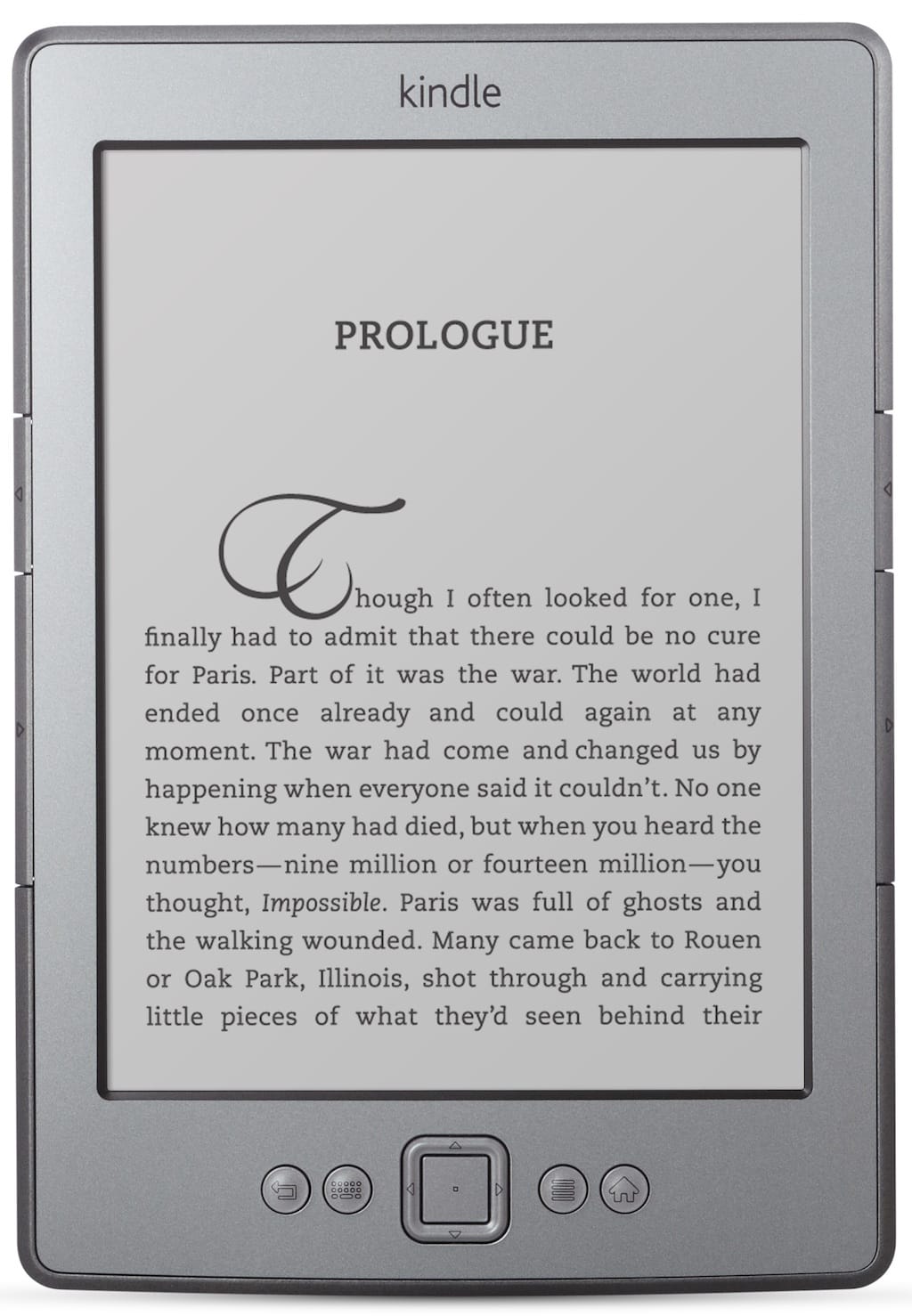
I have a hard time coming up with gift ideas for myself - I'm usually pretty minimalist. So when my husband asked what I might like for Christmas, I came up blank. Then I thought - why not replace my ancient Kindle?  It has dings on the front (from when I let my son Kenny use it) that make it look like there's extra commas scattered across the page, and the right side button to go back a page doesn't work.

My old Kindle
So, I asked for a new, touch-screen Kindle. I didn't want the Kindle Fire, since I'm not looking for a new color computing device, I just want a no-distractions electronic book.

And I got one. Here's my new Kindle, the Paperwhite:

New Paperwhite Kindle
It was great to have the built-in light. But that causes the battery to deplete correspondingly quickly. Another negative - the new Kindle was thicker and heavier.

But, the thing I really couldn't take was the touch screen. I always had to be careful where I touched the new Kindle, because any touch on the front would cause a page turn or some other event. Also, on my old Kindle, turning pages was easy, with the buttons right on the side of the device. With the new Kindle, I had to actually tap the right side of the screen to turn a page. It sounds trivial, but I read very quickly, and I was constantly needing to move my thumb to turn the page, while needing to avoid touching the screen otherwise. Reading basically went from a one-handed operation with the old Kindle to a two-handed one, just like with a paper book.

So, back to Amazon the new Kindle went. And I now have a greater appreciation for my old Kindle.


Saturday, February 07, 2015

My 9 best tips and principles for keeping kids toys organized

After 11 years and 2 boys, I think I have toy organization pretty well handled. Our method is cheap and straightforward, and it's usually not too cluttered around the house. Here are the tips and principles that work for us:

- Cheap wire shelving This is the framework of our storage system. We've partially re-purposed the entry coat closet into a toy storage area, with adjustable wire shelving. It's about 1/3 coats, and 2/3 toys. The wire shelving can be fairly cheap if you don't go all "California Closets", and just stick to the basics you can find at Lowe's or Home Depot.

Our hall closet
- Plastic bins, with blue painters tape for labels. If our toys were out in the open more, we'd probably use something more attractive, but since they're in a closet, this works well. Instead of something more fancy, I just use blue painters tape for labeling, writing on it with a Sharpie pen. These are very easy to remove when I need to use the bin for something else.


- They don't need that much! The animal bin above used to be twice as big, but it didn't add to the "play value", and they just don't need that many of one type of toy. So we sorted through them, and got rid of duplicates and ones they didn't play with. Now everything needs to fit in this bin. If more comes in, something needs to go out.

- Make some toys completely inaccessible. We have a lot of toys - not as much as some familes, but still, they don't all fit comfortably in this closet. So we rotate things out occasionally to the garage. We usually do this every couple months. Some things that get played with a LOT (Legos, Knex) don't get rotated out. When we bring some of the toys back inside, the kids are much more interested in them.

- Pay them to get rid of toys. A year and a half ago, we went to Switzerland for 2 years. We had to get rid of a lot before the move. So, I went through all the stuffed animals, and allowed them to each keep their 5 favorite. My kids were a lot happier giving up the rest when I gave them 25 cents for each, which I didn't mind doing because they don't get an allowance.

- Big clean-ups - about once or twice a year, we do a big clean up. This means everything goes out of the closet, and gets organized and re-evaluated before it goes back in. This is a great opportunity for a garage sale, with the kids deciding what they'd like to sell, and allowed to keep the money. I've tried to have the kids do this on their own, but so far that hasn't worked - they need lots of supervision.

- Have a "lost pieces" bin. This saves time if there's lot of items that belong somewhere else. I just drop it into the "lost pieces" bin, and it will eventually get put back when we do a big clean-up.

Our "lost pieces" bin
- Cheap milk jug bin - this is great when you run out of regular bins, and still have things to put away. It's just a one-gallon milk jug, cleaned up and with the top cut off!

- Clean up before video games - My kids, like most, love playing video games, and are allowed to do that every day for a certain amount of time. Before that happens, though, they need to do a basic cleanup around the house. Linking the cleanup to something they want to do - video games - is a great way to make sure it actually happens.

So there you have it - my best tips, gleaned from years of dealing with frustrating clutter. I hope they give you a few ideas as well!

Saturday, January 31, 2015

Parkinson’s Law - or how Lack of Limits Leads to Laziness

Traditionally, Parkinson's law is the adage that "work expands so as to fill the time available for its completion". But I think my version - Lack of Limits Leads to Laziness - is more memorable.

I've experienced this first hand recently. I've recently taken some time off. First I took this past summer off, for travel with the family. Then when my kids started school, I planned on doing a combination of personal projects, and a more extensive job search than what I normally do, to find a job that really suits me.

However, in reviewing the past few months, I'd have to say I'm disappointed in what I got done - EXCEPT in the weeks between when I accepted a job offer, and when the job actually started (last week). Somehow that fixed deadline, after which I'd have very little spare time, got me to actually get going on some projects that I'd been delaying for quite some time.

I'm not going to theorize about why merely having a hard and fast limit - a deadline - inspires people to be more active. A lot of ink has been spilled on that topic. But I'm a firm believer in deadlines - the more rigorous and "real", with penalties, the better.

As a matter of fact, that's how this blog post is getting written! A friend and I have an agreement. We've mailed each other checks, made out to organizations that we do NOT believe in. If one of us doesn't fulfill this agreement - which relates to regular blogging - then the other will actually mail in the check to the organization. It works like a charm!  Check out this article for some additional info.


Thursday, January 22, 2015

What do people really think on their deathbed?

I've seen this quote repeated ad nauseam in a lot of books, and places I happen to hit on the web:
No one on his deathbed ever said “I wish I’d spent more time at the office.”
Let's think about this a moment. Perhaps nobody has actually said those exact words on their deathbed. In fact, I would imagine that most people aren't busy thinking about regrets during their last moments, if they're even thinking clearly at all.

However, in terms of overall life regrets, I imagine that not finding the right job, staying in the wrong job too long, feeling like you're not contributing to the world enough - these are all huge regrets.

I've certainly felt this way at times in my life. There have been numerous times where I wasn't in a position to influence things, or wasn't doing what I thought was productive work, where the project I was working on was ill-conceived and doomed to failure. Or where I was just marking time, in one way or another, though I was getting paid.

I like this passage much better. It's from the book Rework by Jason Fried and David Heinemeier Hansson.
To do great work, you need to feel that you’re making a difference. That you’re putting a meaningful dent in the universe. That you’re part of something important.
This doesn't mean you need to find the cure for cancer. It’s just that your efforts need to feel valuable. You want your customers to say, “This makes my life better.” You want to feel that if you stopped doing what you do, people would notice.
 You should feel an urgency about this, too. You don’t have forever. This is your life’s work.

Saturday, January 17, 2015

Ditto - the most useful application you've never heard of

What is Ditto?

It's a free clipboard manager, that extends the functionality of the standard Windows clipboard. Everything that you copy to the clipboard is stored, instead of disappearing the next time you copy something. To retrieve it, you just hit a key combination (mine is ctrl + `, the default). There's a search functionality which allows you to search everything you copied, which I use frequently as well.

The user interface. I had been doing some copying/pasting while writing code.
Most people haven't heard of clipboard managers. But whenever anyone is watching me do some work on the computer, and I pop up Ditto, they're always intrigued by it, and can see immediately how it could be very useful.

I haven't tried any other clipboard managers, but I'll stick with Ditto for now. It works, is simple, and works well.

There's a download here.  Enjoy!


Tuesday, January 13, 2015

Yummy, super-easy microwave cheese crisps

Years ago I had fancy cheese crisps as an appetizer at a friends house. It was mind-bendingly delicious. I assumed that some special technique and great skill was required, but it turns out that there's a microwave version that just couldn't be easier. If you have any kind of cheese, then the only thing you'll need to buy is some parchment paper (which is an absolute must).

Here's the steps:

- Slice up some cheese onto parchment paper, in about one inch squares. Actually, the size isn't really critical, nor does it need to be sliced evenly - it'll all melt completely. You can use grated cheese as well, but if you just have block cheese, don't bother grating it. I've tried cheddar and parmesan cheese, and they both work very well. And online, I've seen recipes using other cheeses like mozzarella, etc.

- Put the cheese slices on parchment paper into the microwave. I just put the parchment paper directly onto the microwave tray, but you could put it on a plate as well.

- Microwave it on high power it for about 90 seconds (timing will vary depending on your microwave). The cheese will melt, and after melting will start to get crispy and brownish. Check frequently, at least every 15 seconds or so - definitely don't step away or let it get too brown.

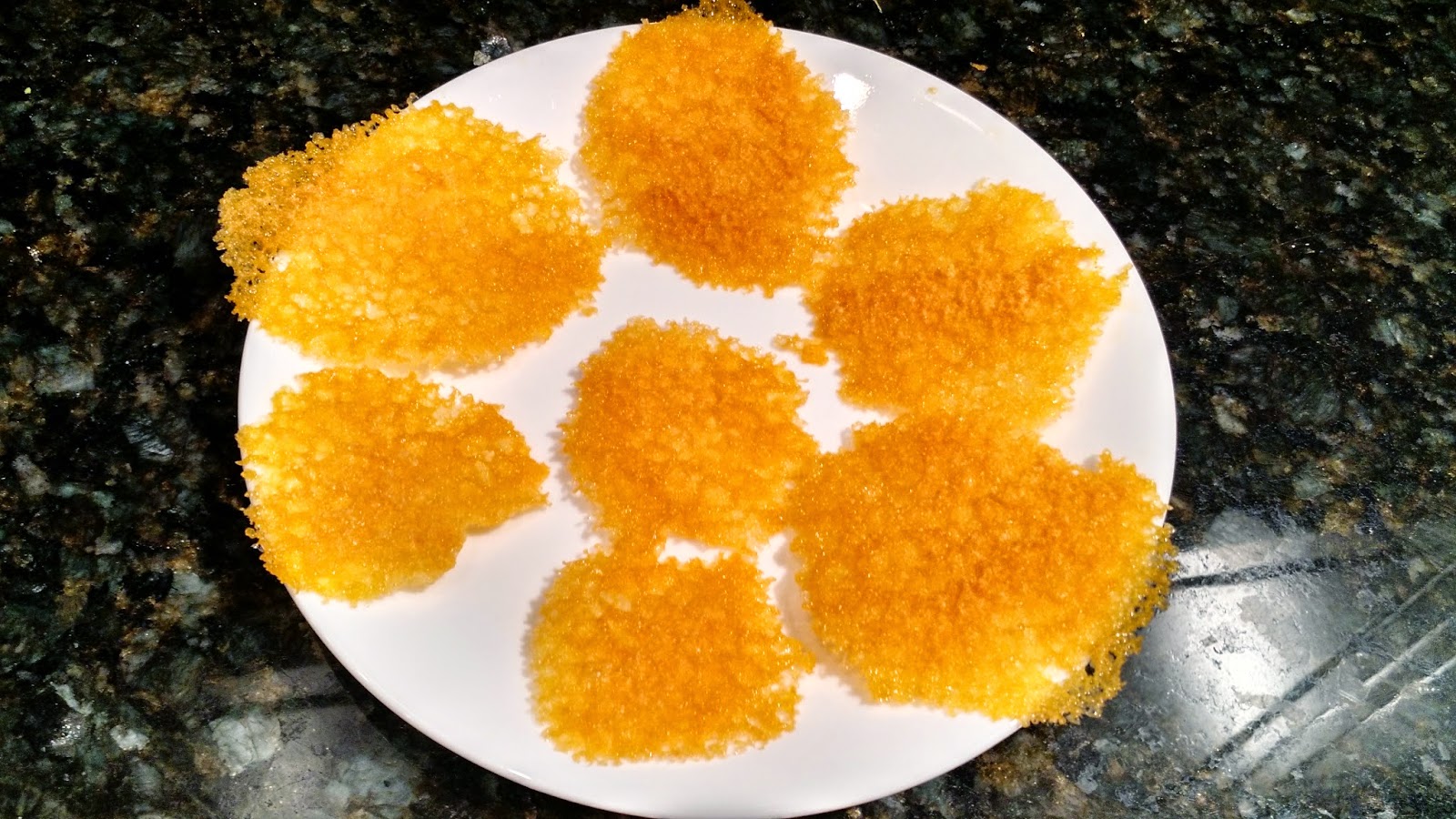
And voila!  Carefully peel the cheese crisps off the parchment paper, and serve.  Crispy, salty, cheesy - what's not to like!

Crispy deliciousness


Friday, December 26, 2014

Losing some weight after holiday feasting

Visiting family over the holidays involves lots and lots of feasting at the house of my in-laws, because my mother-in-law is a very talented chef. Which is wonderful and delectable! Except for when I step on the scale when we get back home. Usually I've gained between 4 and 6 pounds.

I've developed a plan for this, though, which seems to work pretty well. My diet plan is to eat as much as I want, of anything on this list:

  • oatmeal
  • whole milk
  • blueberries 
  • any vegetables (radishes, cabbage, tomatoes, green peppers, etc)
  • hard boiled eggs
  • rye crisp crackers
  • lentil soup
  • Any zero-calorie drinks (coffee, tea, diet soda)

I also add one ounce of butter daily.

I've done this twice now for 3 days, and it's remarkably effective at "resetting" my eating habits after a period of overindulgence.

There's quite a few negatives.

  • It's not a long-term diet plan. Three of four days is probably my limit. This means that it's not great if you have a lot of weight to lose.
  • You don't develop an understanding of calorie counts, like you would if you were actually weighing, measuring, and logging your food.
  • It's hard to go out to eat with people - you'll just be sitting there, drinking your coffee.

But for me, the positives outweigh the negatives by a large margin.

  • It's SO easy! Just eat as much as you want, no need to prep, weigh, measure, and log
  • It's very effective.
  • The foods are all very healthy 

If I need to make it easier to follow the plan for more than a few days, I could add add a few more items to the list, such as plain cottage cheese, plain yogurt, maybe plain roasted peanuts, canned beans.

Notice all the emphasis on "plain". Everything on this list is bland, with no added sugar. Avoiding sugar is part of the whole "resetting" mechanism, and makes food much less addictive. However, all the foods on my list are full-fat, not low-fat or non-fat. You need full-fat foods - otherwise the diet would just have too little fat to be tolerable.


Wednesday, December 17, 2014

How humanizing a boring logic puzzle makes it much easier to solve - the Wason Selection Task -

I can't remember which book I found this in, but I found it fascinating.  Here's the setup for a logic problem:
You are shown a set of four cards placed on a table, each of which has a number on one side and a colored patch on the other side. The visible faces of the cards show 3, 8, red and brown. Which card(s) must you turn over in order to test the truth of the proposition that if a card shows an even number on one face, then its opposite face is red?
It's a dry, boring problem. Here's a more visual representation of the problem: The Wason Selection Task. This is still very dry, but more understandable.

The really interesting part of this is not how bad we are, in general, when presented with this type of logic problem. Rather, it's how good we are when the exact same problem (in terms of the logical structure) is presented in a more natural, human setup:
For example, if the rule used is "If you are drinking alcohol then you must be over 18", and the cards have an age on one side and beverage on the other, e.g., "16", "drinking beer", "25", "drinking coke", most people have no difficulty in selecting the correct cards ("16" and "beer").
There are some theories for why people are so much better at solving this problem when presented in a social context. One author suggests that we have a strong "cheater detection module", that is not as dependent on our logical reasoning power. I also think that any problem, presented more realistic context that you can visualize, would be easier to solve.

I've used the insight from this in my work. For instance, when I'm explaining things and writing sample database code, I put a lot of extra effort into giving realistic table and field names. This makes concepts much more understandable. In this blog post on How to use a column name as an argument in a TOP clause, it took me much longer to come up with the sample code, because I wanted to make it more understandable. But I think that time is definitely worth it, to make it more coherent.

Here's a few links on the topic:
http://www.philosophyexperiments.com/wason/
http://en.wikipedia.org/wiki/Wason_selection_task

One other interesting point - I'd been wanting to write about this for quite some time now, but I couldn't remember what book I found the story in, and couldn't figure out how to look it up ("card problem"?  "logic puzzle"?), and what to search for on Google to find the details. But once I sat down and decided to do it, I searched for this phrase:

 "how many cards do you need to turn over to determine"

And the very first link that came up was correct!

Monday, December 15, 2014

Does the frog REALLY let itself get boiled alive?

Short answer - of course not!

Long answer - I've been reading self-help and business books recently, and it's surprising how many of them have this story:

A frog immersed in boiling water will jump out immediately, but a frog immersed in cold water that is gradually heated will never jump out, and will boil to death.

I wondered if it was true - it certainly didn't seem true.

So I did about a minute of research (thank you, Professor Google!). And I found that it's completely untrue. There's multiple debunkings - here's one from 2006: The boiled-frog myth: stop the lying now!

But there's also still recent references to the boiling frog myth, usually using it as a parable to encourage us to beware of complacency. For instance: Forbes: Leadership And The Boiling Frog Experiment

Why do myths like this stick around? Probably for the same reason that the bible is full of parables - they allow us to easily illustrate the point that we'd like to make, in a way that's understandable and culturally accessible. You could also quite easily find a story that would illustrate the opposite argument, but of course that's not the point. The larger take-away here is the immense power that stories have over us.  A great book on this topic, along with tips on how to tell a good, convincing story, is Made to Stick: Why Some Ideas Survive and Others Die


Friday, November 21, 2014

Exercise - making the habit stick

Over the years I've had numerous conversations with friends about their exercise habits, the marathons they're running, the triathlons, etc. It all sounds like great fun, they train with friends, and then get together for big events. I've never been a big fan of marathons and events like that, but have felt occasional twinges of jealousy over what seem like awesome bonding experiences.

However, these big events frequently don't seem to translate into a steadily established, long-term exercise habit. I've had friends get into such awesome shape that they can run up mountains. But then they slump, not exercising for months or years, to the point that they gain lots of weight, and even going up the stairs gets them winded.

Another downer about these massive, exciting events - people seem to get injuries with great regularity. Blown knees, hip problems, problems with the feet - almost everyone I know who's trained for these big events has these issues.

Meanwhile, I've stayed in reasonable shape with a steady, unexciting program of walking on the treadmill at an incline, or a very brisk pace, and walking around my hilly neighborhood. Occasionally I'll go on longer bike rides (I love being on a bike), or go hiking in the mountains, but nothing dramatic.

The one time I had a personal trainer was about 8 weeks after I gave birth to my second child - too soon! She had me work out so intensively that I was far more sore than I'd ever been - I had a very hard time even walking down the stairs the next few days because of all the squats! A day later I came down with the worst, longest-lasting cold I'd ever had. I definitely think these two facts were related.

My take-away from all of this is the following:

  • It's far better to stay in reasonable shape by working out gently, but daily, than getting in great shape irregularly and then loosing it all.
  • If you're doing strength training, for god's sake take it slow the first few times! You're trying to establish a regular habit, right? If you work up to it more slowly, as opposed to going the "no pain, no gain" route, you'll be much better off in the long run.

At this point I do need to warn you that I can be a little bit too dogmatic with my advice. If the spasmodic, intense exercise routines work for you, then who am I to challenge that? But when the event is over - try getting in a minimal workout of a hilly walk, every day.


Sunday, November 16, 2014

Anemia, pica, and radishes - huh?

I'm writing this slightly weird post just in case somebody has these same symptoms. Starting about 8 months ago, I noticed that I wasn't as energetic as I had been. I wasn't able to work out as hard, and was sometimes a bit out of breath when climbing the stairs or walking uphill. I chalked it up to getting older, and not having as much stamina.

Then in the early part of the summer, I bought radishes a few times, and really enjoyed them. This was past the point of normal enjoying, and getting towards what would be labeled craving. I started eating them like candy - popping a bunch regularly, with salt.

It turns out that it's all related! Any kind of craving like this for a strong tasting vegetable that comes straight from the soil can be a type of pica, and can also indicate a mineral deficiency such as anemia! And of course anemia can cause fatigue and shortness of breath. I had a blood test a few months ago that showed I was anemic, and started taking iron pills. The craving for radishes disappeared shortly thereafter. And thankfully, my stamina went back up to what it was before.

So, if you find yourself craving radishes (and apparently other vegetables too, such as celery), it would probably be a good idea to get an iron test.

Thursday, October 09, 2014

Ladies who Launch kayak trip - east side of Mercer Island

Another lovely kayak trip, starting from the Mercer Island Boat Launch. We've launched from here before, but that was an a Sunday afternoon/evening, and there was a tremendous amount of boat traffic. It made the water extremely choppy and hard to paddle in, we didn't get very far.

It was very different this time. It was very quiet and peaceful, and we saw only 1 other boat. The folding kayaks did well in the water as usual, my only issue, (again, as usual), was assembly, which always feels like a stressful workout. My friend Jean has much more of a knack for it than I do, luckily she helps me out and makes the parts fly together when I get frustrated.

The pictures are from a little detour that we took to Newport Shores - the "little Venice" of Lake Washington, with 2 canals leading into the neighborhood. Seems like a good way to add more "waterfront" to the lake, but I'm pretty sure that environmental regulations wouldn't permit it nowadays.


Tuesday, September 23, 2014

Exercise your brain by solving problems for Innocentive

Over the past few years, I've entered a few Innocentive challenges. What's Innocentive, you say? I'm glad you asked. It's an intriguing concept, a company that wouldn't have existed 10 years ago. Basically it's a clearinghouse for "challenges", where companies post problems that they're facing, and ask for "solutions".  A reward is offered for the best solution, usually between 5 and 10 thousand dollars, although sometimes much more, depending on the complexity of the challenge.

To best illustrate the kind of problems that are posed, let's take a look at some of the current challenges:

– Technology to Enable Packaging Flexibility
The proliferation of various consumer beverages plus increasing retail customer demands for unique pack and pallet configurations requires flexibility in the beverage bottling plant.  The goal is to find a partner with equipment solutions that enable secondary and tertiary package configuration flexibility with minimum manual processes and setup time.

– NASA’s Balance Mass Challenge: Using “Dead Weight” on Mars Spacecraft to Advance Science and Technology
NASA is looking for creative yet practical ideas to find a dual purpose for Balance mass (“dead weight”) that is jettisoned from Mars landers like the Mars Science Laboratory (MSL) to balance the spacecraft during entry and landing.

– Capturing Institutional Memory and Knowledge 
The Seeker desires suggestions and best practices for knowledge management in a corporate setting. As employees age and retire, valuable knowledge is often lost.  In addition, with the realities of today’s workplace, employee turnover needs to be expected.  How can a company proactively capture institutional memory and knowledge, and make sure that it is not lost?

– Detection of Buried Explosive Hazards From a Distance
The Seeker desires novel approaches to detect buried explosive devices from a moving vehicle.  Finding and neutralizing hazards from previous wars is one of the hardest, long standing challenges facing Humanitarian Demining (HD) organizations.

I'm currently working on the challenge "Capturing Institutional Memory and Knowledge". It's actually been a long-standing interest of mine, and the lack of good processes for knowledge sharing has been a continual frustration at the places that I've worked. So I feel I'm pretty positioned to propose some reasonable solutions to this challenge.

One of the frustrations I've had with challenges is that the details are so skimpy. The basic problem in the challenge I'm working on (knowledge sharing and management in corporations) is huge, there are multiple books written on the topic and consulting companies that specialize in this area. So it seems that potential solvers would be more successful if there were more details about specifics that need to be addressed. This has been the case for previous challenges as well.

I've written up two potential solutions so far, and am working on my third. I haven't actually won anything yet, but the potential is tantalizing! And making money by winning something like this would be so much more satisfying than getting a regular paycheck.

Thursday, September 18, 2014

Avoiding unproductive web-surfing


For me, it's always been a challenge to avoid unproductive, time-consuming web surfing - reading news sites, social media sites, online forums, etc. The problem is not with a little bit of web surfing. It's with going to a site that frequently has great content - for instance the Wall Street Journal, the New York Times, certain online forums - and getting interested in things.  Then clicking on links, and finally getting sucked down a rabbit hole, coming up for air a few hours later, fully informed but with hours gone from my life that could have been used more productively. Or at least, not staring at a computer.

The problem is that often, I glean some information that's actually interesting and relevant. For instance, the name of a company that sounds like a great potential employer. It's this pattern of intermittent reinforcements that's so addictive - it's the same force that propels people towards gambling problems as well.

In the past I've installed Chrome extensions (such as StayFocused, etc) that give you a whole framework to make sets of allowed and restricted websites, and set up time ranges of "free time" and "restricted time". And that can work. But it's such a complicated structure that it takes up too much mental space.  I also experimented with ideas like, "only go to the time-wasting websites while standing at the kitchen counter". Or, "only while walking on the treadmill". These can be useful as well, but still - there were just too many rules and thus loopholes.

So finally, I came up with a rule that's drastic, but extremely simple. My rule is this:
No time-wasting web surfing anytime before 9:45 PM. 
And that's it.  No combinations of  various Chrome extensions to limit web surfing, "only while standing" web surfing, no surfing while walking on the treadmill, etc. These were various rules that I tried to combine to limit time-wasting web surfing. Too complex, too many loopholes.

So far it's worked very well. I've been keeping it up for about 3 weeks now. It's a very simple system, and not hard to comply with. I found Gretchin Rubin's blog post Are You an Abstainer or a Moderator? very helpful. She said this insight, this division between Abstainers and Moderators, came to her after reading a quote from Samuel Johnson, "Abstinence is as easy to me as temperance would be difficult.”

In this case, I'm not a complete abstainer, but this satisfies my need for a "bright line" rule - a rule for myself that's very clear, that doesn't require any interpretation.

I found another essay by Paul Graham fascinating. It's called The Acceleration of Addictiveness, and is about how things are becoming more and more addictive (i.e. food, the internet), and the ways in which we as individuals and as a society combat this. Interesting stuff.


Wednesday, September 03, 2014

End of summer round-up

Our family summer, packed with experiences, is now officially over! The kids went back to school yesterday. It's nice to have some good long chunks of free time now, as opposed to engineering a few hours occasionally.  I quit my contract at T-mobile when the kids got out of school in late June, to have some time for the trips we planned this summer.

My mom visited for the first time, we really enjoyed having her and she enjoyed seeing us, and seeing lot of sights in Seattle.

Our visit to the Boeing factory

While she was here, we had Peter's birthday party at the Somerset Recreation Club pool, which worked out well. After my mom's visit, we spent a few days at a hotel in Astoria, Oregon. Great little city, a good place to stay to see the sights in the area. The main sight is Fort Stevens, which I always love because of the setting and all the old ruined military buildings.

Bike ride along the Columbia River

Then we had our friends the Delebecque family visiting our house from Geneva, and later traveled together to Yellowstone National Park with them. It was really enjoyable, and the kids also got to practice their French. Kenny was speaking with them quite well towards the end of the week, and Peter was starting to speak again, but understanding most things.


There's a buffalo in the background here, on the right
After Yellowstone, Eric and Kenny went straight to Oshkosh, Wisconsin, for the "Great American Fly-In", which is a big general aviation event. They went with Eric's friend Roger, and really enjoyed it - Kenny in particular collected tons of swag, which he treasures. While they were gone, Peter and I picked a lot of blackberries in a vacant lot nearby, went swimming a lot at the pool, and also did a camping trip to Deception Pass.

Playing on the beach at Deception Pass

After a week at home, seeing some friends, we took another trip, this time following the Columbia River, starting in Richland (great hotel, right on the riverfront), where Eric was able to take a tour of the Hanford Nuclear Center. Then we drove along the Columbia River, spending a night in Umatilla, and one in Hood River. The area is definitely not a huge tourist attraction - there's plenty of wide open spaces! I enjoy that occasionally, though, going to places that are not as popular.


Preparing to battle the thousands of spider webs draped around the Twin Sisters peak area

In complete contrast to that trip, we next went to Disneyworld. This was a long planned trip for Eric's parents' 50th wedding anniversary. It was an experience - huge, all kinds of things to see, all kinds of rides and attractions. It was sweltering, temperatures in the mid 90's and very high humidity, and the crowds were heavy, but the kids loved it.

At Disneyworld

I had the kids do some "homework" over the summer - mainly writing, on the blogs I set up for them specifically for this purpose, to practice both their typing and writing skills. They were always reluctant, but I had them do it before they got screen time, so it generally worked out.

Swimming was always on the agenda on warm days - and even some rainy days. We joined the Somerset Recreation Club, which has a pool and is only about a 4 minute walk from our house. On sunny days it was pretty full around 4 in the afternoon, but on rainy days (it's heated, so it was warm enough to swim even on rainy days), we were sometimes the only ones there. I swam laps for the first time in a long time. The kids hadn't learned to swim very well before, because they didn't go swimming regularly in Geneva. But here, since we went swimming so often, they improved tremendously even without lessons. So, now they can both swim across the pool. It was also a great place to see kids they knew from school, without having to specifically arrange a playdate.


Thursday, August 07, 2014

More adventures with my foldable kayak

Kelly, Jean's daughter, joined us for a lovely kayak trip off Des Moines Park. It was Kelly's first trip on the Orukayak (Jean and Kelly had set one up before at the same park, but it got so windy that they decided not to put it in the water), and it was my Orukayak's first launch into salt water.


The painful part of going kayaking is setting up my folding kayak. It's not as bad as the first time (it took me about 20 minutes now, the first time it took 90 minutes) but it's still a lot of work. I do try to remember that a regular kayak is a lot of work too - getting it out of the garage, onto the car, then off the car and into the water. It's frequently not even possible for one person to do alone. So, it's the best option for me now.

I just made this little device to make the process smoother. It's a checklist for building the kayak, so I don't always need the manual, and a little piece of dowel to help loosen the seam channels (these are frequently the hardest part to put together).


Jean and I also went for a kayak trip on Lake Union - the best part is seeing all those interesting houseboats!


Monday, July 07, 2014

From roasted marshmallows to s'mores - or the expansion of luxury and why we're all getting fatter!

When I was growing up, my family went camping every summer - first in a large tent, then a pop-up trailer. We had lots of campfires, and we roasted lots of marshmallows. But we never ever made s'mores, and I didn't hear about them until many, many years later - probably sometime in the 1980's.


In the past 10 or 20 years or so, though, just having roasted marshmallows isn't enough. If you're hosting a campfire, you need to have the fixings for s'mores - marshmallows, graham crackers, and chocolate bars. The first written mention of s'mores was in 1925, in the "social section" of the Norwalk Hour. It was written as "some mores", though. It continued as mostly a tradition mostly limited to the Girl Scouts until the 1980's, when it really took off, and now we have veritable smorgasbord of s'more related items (I just couldn't resist!) - a Microwavable S'Mores Maker, numerous s'more cookbooks, and of course many s'more snacks, from pop tarts to cupcake mix.

How did it happen that a perfectly good special occasion treat - roasted marshmallows - became just an ingredient in another, even more special, treat?

I think it's a path followed in the past few hundred years by all luxuries, as the amount of wealth in the world has skyrocketed. First, an item is a luxury - a "gee-whiz", special occasion treat. Then, as we as a society become wealthier, it becomes more and more common. Until finally, we're surrounded by things that were previously special occasion treats.  At that point, the item that's hardest to come by is self-control - to deny ourselves some of these extravagances that make us fat. And that's a serious problem, which cannot be solved by just throwing money at it.

As you might guess, I'm not a fan of s'mores - I'd rather have just regular roasted marshmallows any day.


Tuesday, June 24, 2014

Kayaking - Yarrow Point

This morning Jean and I got to our launch point off NE 42nd Street in Yarrow Point very early - 6:45 AM. The launch point doesn't show up on any maps, I only know about it from having been there before.


Yarrow Point is an area of extremely expensive homes - 5 to 7 million dollars is not uncommon, especially the ones on the waterfront. It's really interesting to paddle around their "backyards" on the water, and get a glimpse of their toys - sailboats, float planes, etc.

The owners of this house set up a sandy beach. It looked great, but the sand was washing away quickly
Jean, posing in front of the biggest boat we've seen so far

The white slide is a track for large orange inflatable balls that you can climb inside, then roll down to the water
Lots of float planes on the water!


Sunday, June 22, 2014

Kayaking - North Lake Sammamish

Another lovely evening kayak trip with Jean. Our staring point was Idlewood Park, which was very popular on this beautiful warm Sunday. We were lucky to find a parking spot, but then had to haul our kayaks down to the water. It wasn't very far, but 26 pounds on a shoulder strap is not very comfortable.


Setup went even faster - less than 15 minutes, I think. For the first time, we had an audience of friendly onlookers. We paddled towards Marymoor Park, and into the Sammamish River.

Right at the entry of the Sammamish River, there were some motorboats that had rafted themselves together and were partying, with beer, dancing (as far as you can on a relatively small boat) and playing very loud music. We paddled past them and saw many herons, two bald eagles, and - a first - two beavers. The beavers seemed to want to scare us off - they spashed the water loudly with their tails. I assume we were close to their babies.


Wednesday, June 18, 2014

Kayaking - Mercer Slough

Last night Jean and I went on our second kayak trip together with our new folding kayaks by Oru Kayak. Assembly of the kayaks is getting faster, but is still between 15 and 20 minutes.

Jean's kayak, in the car
Our destination this time was the Mercer Slough, a slow-moving waterway right next to the blueberry fields off Bellevue Way, and very close to downtown Bellevue. It was a great trip, we saw lots of wildlife including 2 bald eagles from very close by - the closest I've ever gotten. Also many turtles, numerous mama ducks with fuzzy little duck families, and 3 herons.


The slowest moving part of the slough was a little difficult to get through, choked with water plants. But most of it was easy paddling. There's a little office park at the end where I first worked for Microsoft in Bellevue many years ago, doing technical support for their database product, Access.


At the end of our trip, we paddled under Interstate 90 to see what Lake Washington was like. It's much windier than Mercer Slough


Thursday, June 12, 2014

Using Beeminder to keep myself on track

For years - probably more than a decade - I've been trying via various goals, "life hacks", exhortations, etc, to try to get myself to do one thing. That one thing is to review my to-do list every morning, and come up with about 3 things that I must get done that day.

But even though I know, intellectually, that I could get a lot more done and feel better about myself if I were conscientious about this, I didn't do it. I was quite unsuccessful - I would keep it up for a few days, maximum a few weeks. Then despite all my motivational tricks, I would be back at my old habits of procrastination.

Then about a year ago, I found out about commitment contracts and Beeminder. I think I originally came across Beeminder in the book, Carrots and Sticks: Unlock the Power of Incentives to Get Things Done. The authors of this book have their own commitment contract website (Stickk), which I explored, but Beeminder works best for me.

I ended up setting up a few goals in Beeminder. And a few months ago, I just renewed them after my one year anniversary! The longest standing ones have been Morning Planning (review my to-do list and set 3 items as "do today, top priority"; and Doing Top Priorities (actually doing those top priority to-do items).

Every day I get an email for each goal, asking me how I did the previous day. I have it set up as either a yes/no (i.e., I get either 1 or 0 for the previous day, though sometimes on the Doing Top Priorities I give myself a .75 if I almost made it). I've "derailed" a few times - in the Beeminder lingo, this means I've gone of track, and haven't completed my goal in time. Every time this happens, my credit card gets charged a certain amount - it's at $10 right now. And I'm totally fine with that - it provides the "stick" in the carrot and stick analogy, and gives me the extra incentive that I need at times, to stop procrastinating. Not to mention that it pays the bills for Beeminder, which is important to me - I need them to stick around! I'm also a premium member (an extra $30 a year), which gives me more flexibility in the goals.

So what is it that makes me successful now, with Beeminder, when I wasn't successful before? I think it's a combination of two factors:
  • Daily interactive reminder emails. It's not just an email reminder, the email also includes your goal progress in the past few days. And, by replying to the email I update Beeminder with my status for the previous day. This daily nudge, which forces me to evaluate how I did yesterday, is critical.
  • Having to pay if I derail, and don't show progress on my goals. It's not a lot of money, but it's enough to make me think.
I've mentioned Beeminder to a few people, and told them how much I value it. Almost uniformly, they've said that they can't imagine giving a company their credit card number, in order go get charged money if they don't show progress on a goal. I can understand that - it does sound a bit weird. But what can I say, it works for me far better than anything I've ever tried, and I'm not about to stop!


Wednesday, June 11, 2014

Taxi drivers protecting their turf in Europe, protesting ride share companies like Uber

In April of last year when I took a trip to Barcelona with my family, we took taxis a few times. One of these times was on the way back to the airport. We called for a taxi, loaded up our luggage when it arrived and set off. Then after we'd been driving about 20 minutes, and I didn't see any signs indicating that the airport was close by (our apartment was very close to the airport), I looked at the map on my phone. It turns out that we were headed in the complete opposite direction, away from the airport.

I asked the cab driver what was going on. He said, "Oh, there's a marathon going on today, I was just avoiding traffic". He immediately got on the highway heading towards the airport, and we were there in a few minutes. Pathetically, we actually believed he may have been telling the truth, and still gave him a tip when he dropped us off.

Of course, there was no marathon that day, he was just ripping us off by taking us on a long ride. And this isn't the only time we'd been ripped off by taxi drivers - it happened a couple times when we were in Istanbul years ago (taking the "scenic route", and then also being charged the night rate in the middle of the day), and in other cities as well.

What does this have to do with Uber? A lot, really. Had something like this happened on an Uber ride, it would have been very easy to complain - just a few clicks on a smartphone app. And I'm sure it would have resulted in a problem for the driver. Which is why this type of thing happens very rarely, if at all, with Uber.

With a regular taxi, there's realistically no means of complaint. Sure, if you looked carefully enough in the car there may be some kind of registration number, and if you did lots of calling around to government offices you'd probably be able to lodge some kind of complaint. But would anything actually happen to the driver or the company? Unless the taxi driver murdered someone, I doubt it.

I was reminded of some of my taxi horror stories when I read the articles in the Wall Street Journal today about taxi drivers all over Europe protesting the popularity of ride share companies such as Uber. To me, it's just typical protectionism -the taxi drivers and taxi company owners protesting against sorely needed competition. It's nothing new - it's just like the textile workers in 1700's England smashing the power looms introduced by the Industrial Revolution. People protect their own interests.

We used Uber a few times in San Francisco on our last trip there, and it was very impressive. You make a request, a driver accepts the request and you can follow the little car icon on your smartphone screen as they come pick you up. The drivers were always prompt and friendly. Some of them were, in fact, former taxi drivers. I hope they, and other ride sharing companies, prevail and provide some much needed competition to the taxi companies.


Sunday, June 08, 2014

First test of my new OruKayak folding kayak!

I was thrilled to receive my Oru Kayak foldable kayak last week. I was intrigued when I saw it on Kickstarter a few years ago, kept track of them, and decided to go all out and purchase two of them after I saw a demo by an Orukayak engineer on Lake Union.

Roberto, the engineer, was able to assemble the kayak in less than 5 minutes.  I made some assumptions based on that - like, for instance, it would take me maybe 30 minutes the first time, but then I'd rapidly get lots faster.

This is what it looks like, before being folded up in kayak shape

But it took more like an hour and 15 minutes - plus lots of strength! Granted, I'm not a weightlifter or anything, so perhaps I'm weaker than the average user. The kayak shell (which is a corrugated plastic, like what election campaign signs are made of) is very stiff originally, and fitting everything where it belongs was very challenging. The seam channel, that fits the top joint of the kayak together, was so tight that I was not able to fit it on the first time I assembled it. I loosened it up by first running the handle of a hairbrush inside it, and then just mounting and unmounting the seam channel over and over again until it fit a little bit more easily - enough to get the top seam attached, in any case.

Since then, I've assembled the kayak 5 times, and have gotten lots faster. This afternoon when I did it, it probably took about 20 minutes. I hope that someday I'll get to 5 minutes assembly time, like Roberto!

I've only done one trip so far with my new kayak, with my friend Jean. Jean is always up for adventure, came with me to watch the Orukayak demo, and ended up buying one as well! For our maiden voyage we went to Phantom Lake, a calm lake not very far away. The kayaks performed very well, and I look forward to exploring more around here.

My friend Jean on a creek leading into Phantom Lake

Among the water lilies

The Seattle area is really an outstanding area for paddling. I have a whole list of places to go - seeing the houseboats on Lake Union, local rivers such as the Cedar River, and of course the Puget Sound.


Thursday, May 29, 2014

Online shopping, part II: what will happen to social life when more and more transactions happen online?

About 20 years ago, my Uncle Werner, who was a livestock veterinarian in a small town in Austria, told me about his maiden aunt in Vienna when he was growing up in the 1930's. She went shopping several times a day to the little stores on her block - some of them selling fruits and vegetables, some selling dry goods, some dairy, and some meat and sausage.

This was obviously not an efficient way to shop. But she wanted to get out of her tiny apartment, and the more frequently she went out, the more she saw acquaintances to chat with. Very little was sold in packages, almost everything was purchased by weight or by the piece from behind the counter, with a clerk assisting her. For instance, she might buy a quarter kilo of semolina flour, a couple apples, or a few pork chops.

My uncle contrasted this with the large groceries stores that were popping up everywhere in Austria at the time. They were about 30 years behind the US in this regard, but these stores had spread even to the small town that my aunt and uncle lived in, causing the smaller shops to go out of business. Uncle Werner felt sorry for the older people, who wouldn't be able to have friendly, convenient social interactions just by buying groceries.

And what about in this day and age? The days of the local corner shop are in the remote past, and nobody even remembers them. It's rare that you meet someone you know on a trip to the grocery store. And more and more transactions are moving online, as I wrote in my previous post.

So, how do people fulfill their basic human need for friendly social interaction? Most people get it through family, work, or school, but shopping had an important role to play in the past. I'm not a Luddite, and I enjoy shopping online, but I do believe there's something we lose when so many transactions happen online.

What is replacing the face to face aspect of shopping?  I think people will find things, because social interactions are a basic human need. But who knows what form it'll take.


Sunday, May 25, 2014

Online shopping, part I: how almost all my shopping now begins and ends on Amazon.com

If I were a regular retailer - say, Target, or Walmart - I'd be running scared. Judging by myself, regular retailers have been loosing market share to Amazon in a big way. I used to go to the local Target about once a week, but now I go only rarely - maybe once a month. And it's very close to us, about a 5 minute drive. Sure, it's close, but Amazon is even closer - right at my fingertips, along with mind-boggling choice and reviews that make me more comfortable with my choice.


In the past 6 months, I've placed 43 orders (I know because of the handy order reporting on Amazon), for items such as a new set of bedroom furniture, a hummingbird feeder, a roll of self adhesive window film, luggage, an egg slicer, magnetic push pins, shoe goo, an exercise mat, a mini vacuum, tennis racquet, some jewelry, etc. And...oh yes, a few books. I could go on, but my point is, almost everything that I previously bought at Target or some other local retailer, I'm now buying on Amazon.

Why is this? Well...it's just so much more convenient. It's rare that I need something right this minute - most of the items I buy are wants instead of needs, and so the 2 day free delivery (we're Prime members) is fine for me. Then it's delivered to my front door, hassle free. Now, when I look at the selection of items available at the local Target, it seems kind of skimpy. And sometimes I think to myself, when looking at an item at Target - I'd really like to know what people who own this actually think of it. In other words, I want reviews!

Yes, the reviews - that's another huge reason that I'd just rather buy it on Amazon. The reviews are a big draw. It used to be that I would look up books on Amazon, read the reviews, decide whether or not I liked it, and then get it at the local library. I actually felt a tiny bit guilty about this.

But now the first step of shopping for anything - not just books - is to look at the reviews on Amazon. They're not uniformly helpful - I've found that too frequently, they're overly positive, and that the negative reviews are actually more accurate. It's as thought people take the saying "if you can't say anything nice, don't say anything at all" to heart. But they're still by far the best reviews online. It's just such a robust system - you can comment on reviews, you can mark them as helpful, you can of course actually write reviews. Reviews on the websites of other retails just seem to be tacked on as an afterthought, and not at all central to the experience.

So, where are other retailers planning on doing to fight the rise of Amazon? It'll be interesting to see what happens in the next few years.


Friday, May 16, 2014

In life, it's more fun to participate rather than consume

This thought came up last night, when I was an usher for a musical, the Little Shop of Horrors.  I've never done anything like that before, but a friend of mine had, and said that it was an outstanding show (it was!). So I arranged to be an usher via a few emails. The responsibilities of the usher aren't very taxing - you basically take tickets, and tell people where the bathrooms are. I had to show up an hour before the play for the training, which involved an orientation to the theater, where the men's and women's bathrooms are, and what's not allowed into the theater (glass containers, hot drinks without lids, food). Then I got a little basket for ticket stubs, and started ushering - tearing off ticket stubs, giving out programs, etc. I was in an area that got very few people (Gallery left), so it wasn't too stressful.

I definitely noticed that my customer service skills have gotten rusty - I haven't done much public-facing customer service in a very long time. It takes a whole different set of behaviors that for someone that's introverted like me, take a while to adjust to (greeting strangers, offering them programs, etc).

And the payoff - watching the show! It was a really fun, energetic show, and I got to see it up close - all the ushers were seated in the second row! I've never sat that close at a play before, and it was a real thrill to be able to almost touch the actors.

It's can be more fun to actually participate in something, then just to be a consumer. In this case, it was interesting to get behind the scenes a little bit, albeit in a pretty minor, insignificant way as an usher, than to just buy a ticket and watch the show.


Monday, May 12, 2014

My investing mistakes through the years

The very first investment I ever made was during my college years at Chapel Hill.  I had a little bit of money saved up - maybe 5,000 dollars - and decided to try investing it. Every year, Money magazine published an article listing the mutual funds with the highest annual returns. Sometime in the last 1980s, at the tippy-top of this list was a mutual find called the Tiger Fund, with a return for the year of 90%.

So of course, I put all my money into the Tiger Fund.  Who wouldn't? Why settle for number two, when you could put your money into number 1, and earn close to a 90% return?  Of course, you probably wouldn't get exactly a 90% return the next year. But I figured it would get pretty close - say, 60%. So I'd have no complaints.

Yes, that's really what I thought back then. I usually have a strong leaning towards skepticism, but certainly not in this case.

I lost a good amount of money in this fund, and then got out.

The very next investment I made was a closed end mutual fund. My parents are Austrian, so when I saw that a closed end, country-specific fund for Austria had the highest annual return of all closed end funds, I was drawn to it.  After all, Eastern Europe was just opening up, and Austria, bordering at that point with Czechoslovakia, Hungary, and Yugoslavia was a natural to take advantage of new opportunities. Right?

Well, that was another fiasco. I got out of it after losing what was, to me back then, a lot of money.

This wasn't the end of my investment strategy of chasing last year's highest returns. I experimented with a biotech mutual fund (I didn't do as badly with that one), and a few others.

But I gradually wised up. I read up on investing strategy, and started investing in broad based index funds exclusively.

Some of my favorite books were The Only Investment Guide You'll Ever Need by Andrew Tobias and The Four Pillars of Investing by William Bernstein. Reading these convinced me that I'm not Warren Buffett, that I wasn't going to be able to beat the market in general, and that I'd be better off not even trying.

Right now I stick with a well-balanced portfolio of a few index funds. It's not interesting, and it's not ego-boosting.  You can't tell people how your investments are beating the markets because of your well-chosen plan. But it's easy, and stable, and works very well.

I've thought about how to teach my two children about investing. However, aside from some basic table talk about how investing works, and what a stock is, it's premature for them. First they need to learn how to save money (ideally their own money, that they've earned), and only then, investing. So we have some time to spare.